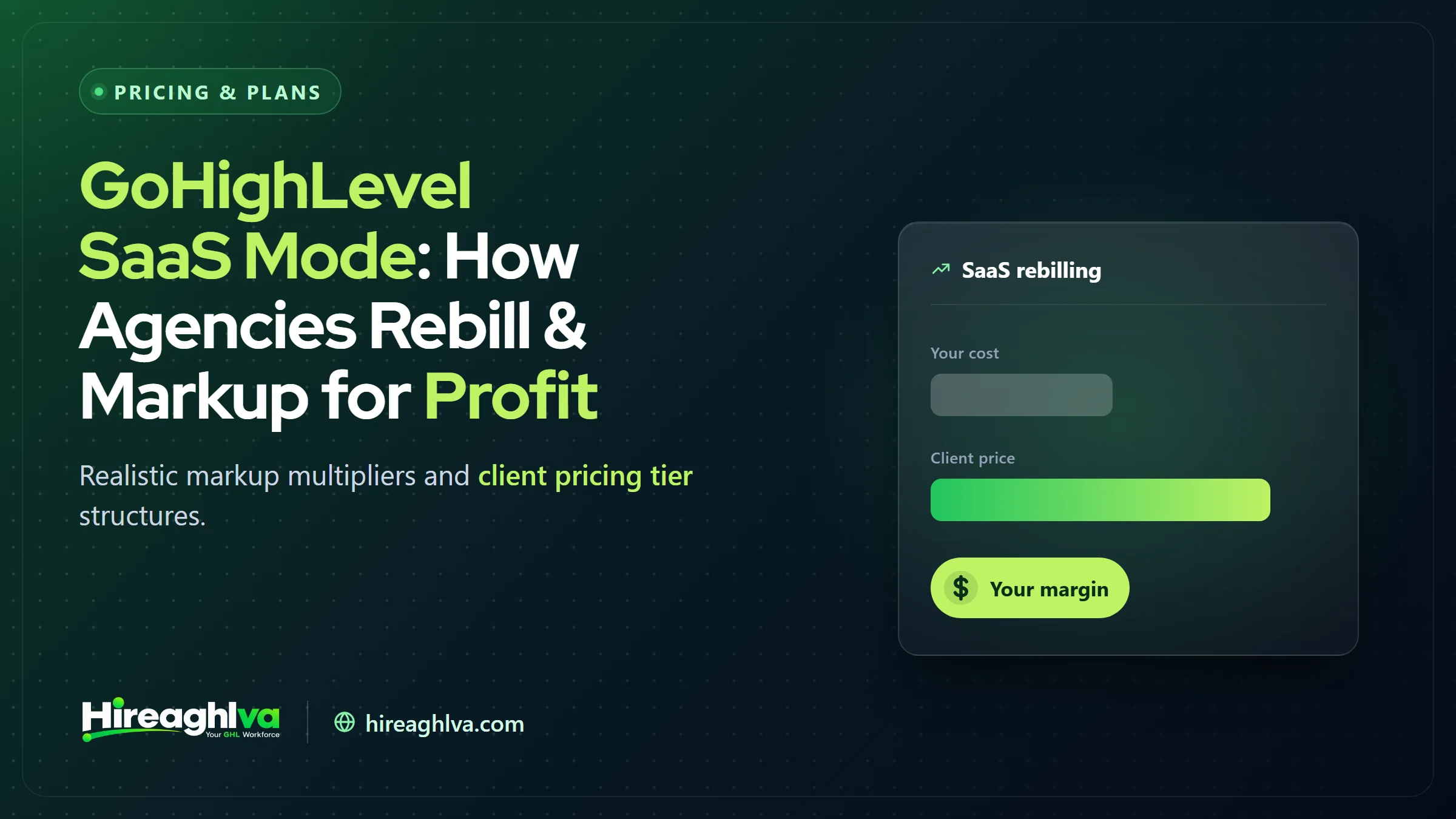
GoHighLevel SaaS mode is the Agency Pro ($497/month) feature that lets an agency resell the platform under its own brand and rebill SMS, email, AI, and phone usage to clients at a markup it controls. It’s what turns GoHighLevel from “a platform you use” into “a platform you resell under your own brand, at your own price.” This guide covers exactly how rebilling works, what markup ranges are realistic by cost category, and how to structure pricing that’s profitable without feeling exploitative to your clients.
This is arguably the single highest-leverage financial decision an agency running GoHighLevel makes — get rebilling structure right, and it becomes one of the largest, most scalable margin sources in the business; get it wrong (flat rates that don’t account for usage variance, no markup on high-value AI categories, fully itemized invoices that invite scrutiny), and it becomes a source of quiet, ongoing margin erosion that’s easy to miss until a P&L review makes it obvious.
Agency Pro
The $497/mo tier required to unlock rebilling and SaaS mode
2–2.5x
Typical markup range on SMS/email usage costs
3–5x
Typical markup range on AI usage (Conversation AI, Voice AI)
What is GoHighLevel SaaS mode?
GoHighLevel SaaS mode lets an Agency Pro subscriber white-label the entire platform — CRM, funnels, AI bots, automation, communications — under their own brand, and rebill usage (SMS, email, AI, phone) to their own clients at a markup they control, with Stripe handling the actual client billing. In practice, this means your clients see your brand, log in at your domain (with the branded desktop app), and pay you directly — GoHighLevel itself becomes invisible to them. If you’re still deciding how much of that client-facing experience to customize, our guide to white-label client portals and reporting in GoHighLevel covers the branding side in depth.
What you can and can’t mark up
SMS usage
- Can rebill/markup
- Fixed cost, no markup lever
Email usage
- Can rebill/markup
- Fixed cost, no markup lever
Conversation AI usage
- Can rebill/markup
- Fixed cost, no markup lever
Voice AI usage
- Can rebill/markup
- Fixed cost, no markup lever
Phone number rental
- Can rebill/markup
- Fixed cost, no markup lever
A2P 10DLC registration fees
- Can rebill/markup
- Fixed cost, no markup lever
| Can rebill/markup | Fixed cost, no markup lever | |
|---|---|---|
| SMS usage | ||
| Email usage | ||
| Conversation AI usage | ||
| Voice AI usage | ||
| Phone number rental | ||
| A2P 10DLC registration fees |
A2P 10DLC registration fees are typically passed through at cost or bundled into an onboarding fee rather than marked up significantly — they’re small enough one-time amounts that heavy markup looks disproportionate, and most agencies don’t bother itemizing them separately at all. Our complete guide to A2P 10DLC for GoHighLevel users explains what the registration involves, which is useful reference material when deciding how (or whether) to reflect it in a client-facing onboarding fee.
How much should agencies mark up GoHighLevel usage?
A common range is 2–2.5x on SMS and email usage and 3–5x on Conversation AI and Voice AI usage, with A2P 10DLC registration fees passed through at cost. The chart below shows the low and high end of each cited range.
| Item | Value |
|---|---|
| SMS/Email (low end) | 2x |
| SMS/Email (high end) | 2.5x |
| AI usage (low end) | 3x |
| AI usage (high end) | 5x |
Source: hlgrowthpartner.com, GoHighLevel Rebilling: How to Mark Up SMS, Email & AI Usage
For SMS specifically, a 2–2.5x multiplier is generally considered safe — clients are price-aware on basic messaging since they can compare it against a previous provider’s rate. AI services support higher multipliers of 3–5x because the perceived value (automated booking, 24/7 response handling) is meaningfully higher than raw message-sending capacity in a client’s eyes (hlgrowthpartner.com, GoHighLevel Rebilling: How to Mark Up SMS, Email & AI Usage).
Why AI markup tolerance is higher than SMS markup tolerance
It’s worth understanding the underlying reason clients accept a 3–5x markup on AI usage far more readily than they’d accept the same multiplier on SMS, since this reasoning should drive your own pricing decisions rather than just copying the multiplier as a rule of thumb. SMS is a commodity the client can price-check easily — a quick search or a call to a previous provider reveals roughly what a text message “should” cost, making an aggressive markup feel obviously inflated if noticed. Conversation AI and Voice AI, by contrast, aren’t being compared against a raw per-message or per-minute commodity rate in a client’s mind — they’re being compared against the cost of a human doing the equivalent work (answering calls, responding to inquiries, booking appointments), which is dramatically more expensive on an hourly basis than even a heavily marked-up AI usage rate. This is why AI markup isn’t really “exploiting” a client — it’s pricing based on the value delivered (automated staff-equivalent capacity) rather than the underlying compute/telephony cost, which is a legitimate and common software business pricing pattern, not specific to GoHighLevel rebilling. If you’re weighing GoHighLevel’s native voice agent against standalone platforms before setting that markup, see our GoHighLevel Voice AI vs. Bland, Retell, Synthflow and Vapi comparison.
Fixed-rate vs. markup-based rebilling
GoHighLevel supports both fixed-rate rebilling (charging a client a flat, predetermined rate per unit — e.g., a flat $0.02/SMS regardless of your actual underlying cost) and percentage-markup rebilling (charging your actual cost plus a set percentage) for AI products specifically (HighLevel Support, Fixed-Rate Rebilling for AI Products). Fixed-rate is simpler for clients to understand and budget around; percentage-markup scales your margin automatically as underlying costs shift, without requiring you to manually update client-facing rates each time.
Structuring client-facing pricing tiers
Rather than itemizing every usage cost line-by-line on a client invoice (which invites scrutiny and comparison-shopping), most successful agency pricing bundles usage into a small number of clear tiers:
Starter tier
- What it typically includes
- Core CRM/automation, modest SMS/email allotment
- Positioning
- Entry point, lower AI usage
Growth tier
- What it typically includes
- Higher usage allotment, Conversation AI included
- Positioning
- Most common mid-tier sweet spot
Premium/AI-first tier
- What it typically includes
- Unlimited or high-cap usage, Voice AI included
- Positioning
- Highest margin, positioned on automation value
| What it typically includes | Positioning | |
|---|---|---|
| Starter tier | Core CRM/automation, modest SMS/email allotment | Entry point, lower AI usage |
| Growth tier | Higher usage allotment, Conversation AI included | Most common mid-tier sweet spot |
| Premium/AI-first tier | Unlimited or high-cap usage, Voice AI included | Highest margin, positioned on automation value |
This bundled-tier approach protects your margin on high-usage clients within a tier (since a client using slightly more than average doesn’t trigger a renegotiation) while still giving clients predictable, easy-to-understand pricing rather than a variable, itemized bill that changes month to month.
It’s worth deliberately building some usage headroom into each tier’s assumed cost basis — pricing a tier around the average expected client usage, with enough margin buffer that a moderately above-average client doesn’t tip the tier into unprofitable territory, rather than pricing tightly around a best-case usage assumption that only holds for your lowest-usage clients.
How do you set up GoHighLevel SaaS mode?
To set up GoHighLevel SaaS mode, confirm you’re on Agency Pro, connect Stripe, define pricing tiers, configure per-category rebilling rates, add white-label branding, and test the client billing flow. Getting rebilling live involves that specific sequence, and skipping steps or doing them out of order is the most common source of setup frustration:
- Confirm you’re on Agency Pro. Rebilling and SaaS mode configuration aren’t available on Starter or Unlimited — upgrade first if you’re not already there.
- Connect Stripe. GoHighLevel’s rebilling infrastructure routes client payments through your own connected Stripe account, not through GoHighLevel’s own payment processing — this is what allows client-facing billing to appear as coming from your business, not GoHighLevel.
- Define your pricing tiers. Decide on your tier structure (see the bundled-tier guidance above) before configuring anything in the platform — retrofitting pricing tiers after clients are already billed under an ad hoc structure is more disruptive than deciding upfront.
- Configure usage rebilling rates per category. Set your markup or fixed rate for SMS, email, Conversation AI, and Voice AI individually — these don’t have to use the same multiplier across categories, and per the guidance above, they generally shouldn’t.
- Set up your white-label branding. Custom domain, logo, and (if included in your tier) the branded desktop app — this is what makes the platform feel like your own product to clients rather than a visibly repackaged GoHighLevel account.
- Test the full client billing flow before onboarding real clients. Create a test sub-account, simulate usage, and confirm the invoice a client would actually see matches your intended pricing structure and branding before it’s live in front of a paying client. Loading each new sub-account from a tested prebuilt GoHighLevel snapshot keeps what every tier includes consistent from client to client.
SaaS mode setup sequence at a glance
| Step | What you do | Why it matters |
|---|---|---|
| 1. Confirm Agency Pro | Upgrade from Starter or Unlimited if needed | Rebilling and SaaS mode are not available on lower tiers |
| 2. Connect Stripe | Link your own Stripe account | Client billing appears to come from your business |
| 3. Define tiers | Decide tier structure before configuring | Retrofitting tiers after billing starts is disruptive |
| 4. Set usage rates | Markup or fixed rate per category | SMS, email, and AI generally should not share one multiplier |
| 5. Brand it | Custom domain, logo, branded desktop app | Platform feels like your product, not repackaged GoHighLevel |
| 6. Test billing | Test sub-account with simulated usage | Catches invoice and branding errors before a paying client sees them |
A worked pricing tier example with real numbers
Concrete numbers make the tier structure concept easier to apply. Take a home-services-focused agency running Agency Pro, with three client tiers:
Starter tier
- Client price/mo
- $297
- Underlying GHL cost (est.)
- ~$110
- Gross margin
- ~63%
Growth tier
- Client price/mo
- $497
- Underlying GHL cost (est.)
- ~$180
- Gross margin
- ~64%
AI-first tier
- Client price/mo
- $897
- Underlying GHL cost (est.)
- ~$320
- Gross margin
- ~64%
| Client price/mo | Underlying GHL cost (est.) | Gross margin | |
|---|---|---|---|
| Starter tier | $297 | ~$110 | ~63% |
| Growth tier | $497 | ~$180 | ~64% |
| AI-first tier | $897 | ~$320 | ~64% |
Notice the margin percentage stays roughly consistent across tiers even as the absolute dollar figures scale up — this is the point of a well-designed tier structure: it scales your revenue and margin together as a client’s usage grows, rather than requiring you to renegotiate pricing every time a client’s volume increases within the tier’s expected range.
A 20-client agency P&L illustration
Scaling the same logic across a client base makes the business case for rebilling concrete. An agency with 20 clients split roughly across the three tiers above (say, 8 Starter, 8 Growth, 4 AI-first) generates approximately:
~$9,940/mo
Total client revenue (8×$297 + 8×$497 + 4×$897)
~$3,600/mo
Total underlying GHL cost (8×$110 + 8×$180 + 4×$320)
20-client rebilling P&L in the illustrative example above
| Tier | Clients | Client revenue/mo | Underlying GHL cost/mo | Gross margin/mo |
|---|---|---|---|---|
| Starter ($297) | 8 | $2,376 | $880 | $1,496 |
| Growth ($497) | 8 | $3,976 | $1,440 | $2,536 |
| AI-first ($897) | 4 | $3,588 | $1,280 | $2,308 |
| Total | 20 | $9,940 | $3,600 | $6,340 |
That’s roughly $6,300/month in gross margin — or about $5,800/month after the $497/month Agency Pro base subscription — before accounting for the agency’s own labor, sales, and support costs — a useful illustration of why rebilling, done deliberately rather than as an afterthought, is often a larger driver of agency profitability than the service fees charged for setup and management work alone.
Common rebilling mistakes agencies make
Charging every client an identical flat rate regardless of actual usage. A client sending 10x the SMS volume of another, both on the same flat tier, either erodes your margin on the high-usage client or overcharges the low-usage one — usage-aware tiers (or usage caps with overage pricing) protect against this better than one universal flat rate across every client regardless of behavior.
Forgetting to update rebilling rates when GoHighLevel’s underlying costs change. If Voice AI’s underlying cost structure shifts (as it did with the May 2026 unbundling), a percentage-markup rebilling structure adjusts automatically, but a fixed-rate structure set months earlier won’t — periodically auditing fixed rates against current underlying costs prevents a slow margin erosion that’s easy to miss month to month. A dedicated GoHighLevel VA can own that recurring rate audit so it doesn’t slip.
Itemizing every usage line on client invoices. This invites comparison-shopping and scrutiny of your specific markup multiplier in a way that a bundled, tiered flat price generally avoids — most agencies are better served showing a clean, simple invoice than a granular cost breakdown that essentially hands the client your pricing math.
Not accounting for A2P 10DLC and setup costs in initial client pricing. One-time registration and onboarding costs are real expenses at the start of every client relationship (our walkthrough on how to submit A2P 10DLC registration in GoHighLevel shows what that onboarding step involves) — folding a reasonable onboarding fee into your pricing (rather than absorbing it silently) protects your margin on the client relationships that don’t last long enough to amortize that upfront cost across many months.
A practical middle ground between fully itemized and fully opaque: show clients a single “Platform & Communications” line item on their invoice rather than a granular SMS/email/AI breakdown. This is honest (it’s not hiding that a cost exists) without inviting a line-by-line negotiation on your specific markup for each category.
Legal and disclosure considerations
Reselling a platform under your own brand doesn’t remove your obligation to be honest about what a client is actually purchasing, even if GoHighLevel itself is invisible in the branding. Most agencies handle this by including clear terms in their own client service agreement describing what’s included, how usage-based components work in general terms, and what happens if a client’s usage substantially exceeds their tier’s typical range — this protects both sides from a dispute later and doesn’t require disclosing your specific markup percentage, just the general billing structure a reasonable client would want to understand before signing.
Frequently asked rebilling questions
“Can I change a client’s rate after they’ve been on a tier for a while?” Yes, technically, but this should be handled the same way any subscription price change would be — with advance notice and clear communication, not a silent adjustment a client discovers on their invoice without warning.
“What happens if a client’s usage massively exceeds what their tier assumed?” This is exactly what usage caps or overage pricing within a tier structure are designed to handle — define this upfront in your tier structure and client agreement, rather than absorbing an unexpectedly large cost silently or having an uncomfortable renegotiation conversation after the fact.
“Is rebilling only viable at scale, or does it work for a small agency with a handful of clients?” It works at any scale, though the absolute dollar impact is naturally smaller with fewer clients — even a 5-client agency benefits from usage-aware pricing and reasonable AI markup, since the same margin percentages apply regardless of client count, just against a smaller total revenue base.
Handling client churn and pricing changes gracefully
Rebilling structure also affects how cleanly you handle client offboarding and price changes — two situations that create real friction if not planned for. When a client leaves, make sure your Stripe-connected billing actually stops charging them at the point of cancellation, not on a delayed cycle that generates a dispute; test this specifically rather than assuming it works correctly by default. When you need to raise rates (underlying GoHighLevel costs shift, your own cost structure changes), give existing clients real advance notice — 30 days is a reasonable minimum — and consider grandfathering long-tenured clients at a lower increase than new clients face, which tends to reduce churn from a price change more than an across-the-board increase applied uniformly regardless of relationship length.
Bringing it together
SaaS mode and rebilling turn GoHighLevel’s usage costs from a pure expense into a genuine profit center — but only if you price deliberately rather than guessing. Use SMS/email markup in the 2–2.5x range, lean into higher AI markups (3–5x) where the perceived client value supports it, and bundle usage into clear tiers rather than itemizing every line. Get this structure right, and the usage layer that looks like a pure cost on your GoHighLevel bill becomes one of the more reliable margin drivers in an agency’s GoHighLevel-based offering.
Whether you’re setting this up for the first time or auditing an existing rebilling structure that’s grown organically without much deliberate design, the worked P&L example and tier structure above are a reasonable starting template — adjust the specific multipliers to your market and client base, but keep the underlying principle: price commodity usage conservatively, price AI-driven value aggressively, and bundle rather than itemize wherever you reasonably can.
Written by the Hireaghlva GoHighLevel team
We build and run GoHighLevel accounts, automations, dashboards, and websites for agencies and local businesses across the US and Canada. This guide reflects that hands-on work, with sources cited inline where we reference outside data.