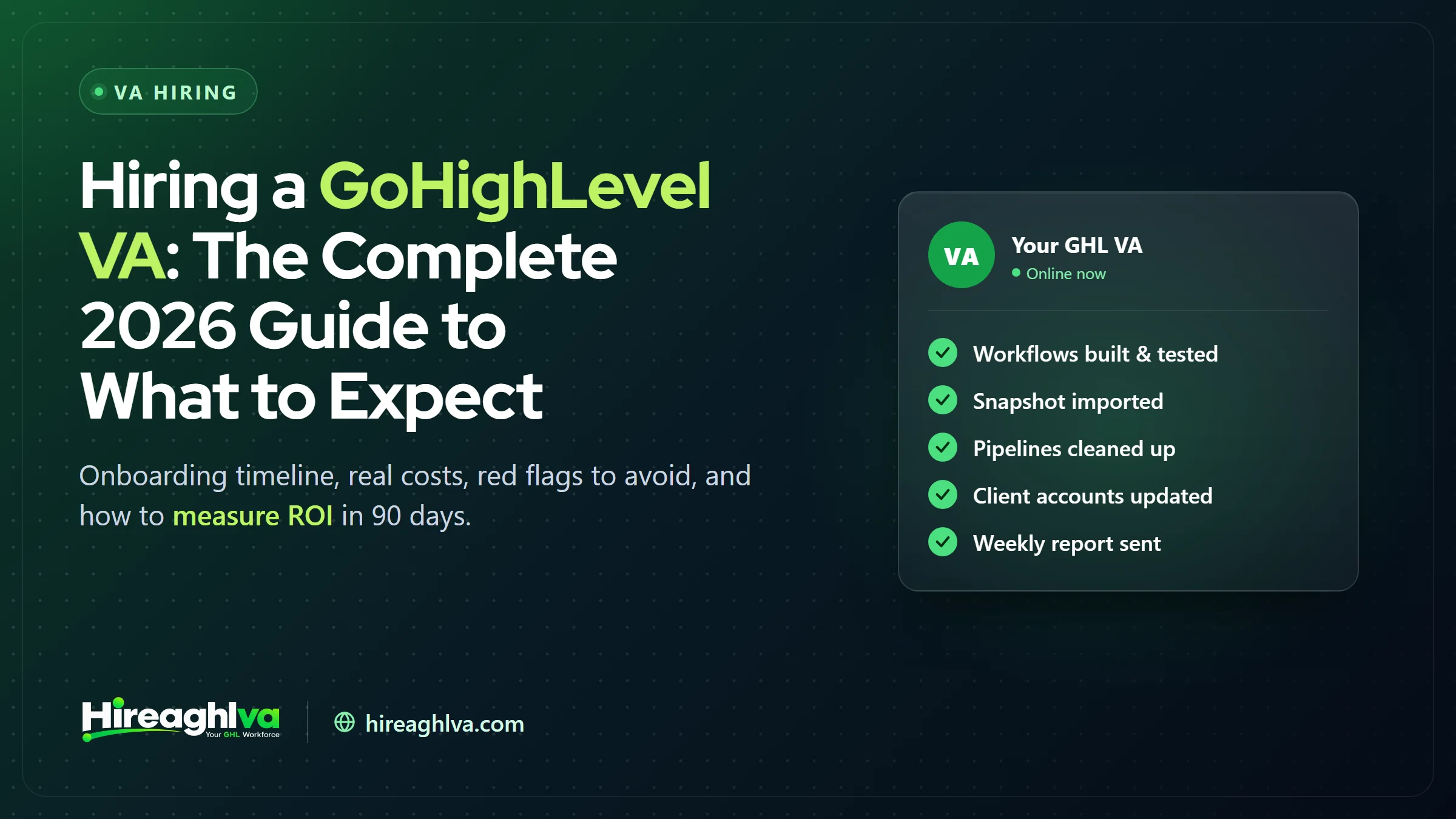
Hiring a GoHighLevel VA means bringing on a platform specialist who takes over your GHL automations, snapshots, dashboards, and backlog, typically ramping to independent work within 30 days. Most agencies and business owners don’t wake up one day curious about virtual assistants. They hire a GoHighLevel VA because their GHL account has quietly become a second job — automations half-built, snapshots imported but never customized, a dashboard nobody fully trusts, and a backlog of “I’ll get to it” tasks that keeps growing instead of shrinking.
This guide walks through what actually happens when you bring on a dedicated GHL VA: realistic costs, a week-by-week onboarding timeline, which tasks to hand off first (and which to keep), the red flags that predict a bad hire, and how to know — with actual numbers, not just a feeling — whether the arrangement is working by day 90.
Why GoHighLevel specifically needs a specialized VA
GoHighLevel is not a simple tool to delegate. It’s a genuinely dense platform — pipelines, funnels, workflows, custom objects, calendars, memberships, and a triggers/actions automation engine that behaves differently depending on how your account is structured. A generalist virtual assistant who’s “good with computers” can learn the surface of GHL in a few days. Learning to build automations that don’t silently break, that route leads correctly under edge cases, and that don’t quietly duplicate contacts or double-book calendars takes real, platform-specific experience.
This is the core argument for hiring a GHL-specialized VA rather than a general VA and hoping they pick it up: the failure modes in GoHighLevel are subtle. A broken automation doesn’t usually throw an error — it just quietly stops firing, or fires with the wrong delay, or triggers on the wrong pipeline stage. A generalist VA won’t know to check for that. A GHL specialist will, because they’ve been burned by it before on someone else’s account.
The most expensive GHL mistakes are the ones that fail silently — a follow-up sequence that stops firing, a lead source tag that stopped applying three weeks ago. A specialist VA builds in verification steps specifically because these failures don’t announce themselves.
How much does a GoHighLevel VA cost?
A specialized GoHighLevel VA typically starts around $20 per hour; dedicated plans run $600 per month part-time (~20 hrs/week) or $997 per month full-time (~40 hrs/week), and senior automation specialists cost more.
Pricing in this space varies more than most buyers expect, largely because “GHL VA” gets used to describe everything from a junior assistant who imports snapshots to a former agency operations lead who architects custom object schemas. Here’s how the hourly example used later in this guide compares with our dedicated plans:
| Item | Value |
|---|---|
| Hourly example, 10 hrs/mo at $25 | 250 |
| Part-time plan (~20 hrs/wk) | 600 |
| Full-time plan (~40 hrs/wk) | 997 |
These ranges assume a dedicated VA (one person consistently on your account) rather than a shared pool, which tends to run cheaper on paper but costs more in re-explaining context every time a different person picks up your ticket. For our own dedicated plans, see GoHighLevel VA pricing.
$20+
Starting hourly rate for a specialized GHL VA
20 hrs
A common part-time weekly allocation
40 hrs
A common full-time weekly allocation
5 biz days
Reasonable turnaround to be matched and started
What drives the price difference
Three factors move the price more than anything else: automation complexity (basic workflow edits vs. multi-branch conditional logic with API calls), custom object/API work (genuinely developer-adjacent, priced closer to junior dev rates), and account ownership (a VA who owns your reporting and strategy costs more than one who executes a fixed task list).
How long does it take to onboard a GoHighLevel VA?
A new GoHighLevel VA typically spends week 1 on access and discovery, ships first fixes in weeks 2–3, works independently by day 30, and reaches full account fluency in 60–90 days.
Every GHL VA engagement — regardless of how experienced the VA is — goes through the same rough phases. Skipping or rushing phase one is the single most common reason a new VA relationship underperforms in the first month.
Week 1: access, discovery, and expectations
The first week isn’t about output. It’s about making sure week two doesn’t need to be redone. A properly onboarded VA spends the first few days:
- Getting scoped account access (sub-account or agency-level, with documented boundaries)
- Auditing existing pipelines, automations, and custom fields to understand current state
- Reviewing your task backlog and re-prioritizing it by actual business impact, not just by what’s been sitting longest
- Agreeing on a communication cadence and where async updates will live
This is also when access boundaries and confidentiality expectations should be documented in writing — not a formality, but the thing that protects you if the relationship doesn’t work out.
Weeks 2–3: first fixes and quick wins
A capable VA doesn’t start with the most ambitious rebuild on your list. They start with the highest-leverage, lowest-risk fixes: a broken trigger silently dropping leads, a stalled follow-up sequence, a dashboard metric that’s been wrong for months. These fixes are usually visible fast, and they’re often what convinces a skeptical business owner the arrangement is worth continuing.
By day 30: independent execution
By the 30-day mark, a good VA should be working through your priority list with minimal hand-holding, flagging blockers proactively instead of waiting to be asked, and starting to suggest improvements you hadn’t thought to request. If a VA is still asking basic “how does this work” questions about your business at day 30, that’s a signal worth addressing directly rather than hoping it improves.
| Item | Value |
|---|---|
| Access & discovery done (week 1) | 7 days |
| First fixes shipped (weeks 2–3) | 21 days |
| Independent execution | 30 days |
| Full account fluency | 90 days |
What tasks should you hand off to a GHL VA first?
Hand off mechanical, reversible GoHighLevel work first — snapshot imports, routine automation maintenance, and dashboards — and keep pricing, strategy, and billing configuration in-house.
Not every GHL task should go to a VA on day one — and some things shouldn’t go to a VA at all without very deliberate scoping. Here’s a practical breakdown.
Snapshot imports & branding
- Hand off immediately
- Hand off after 30 days
- Keep in-house / scope carefully
Routine automation maintenance
- Hand off immediately
- Hand off after 30 days
- Keep in-house / scope carefully
Dashboard building & reporting
- Hand off immediately
- Hand off after 30 days
- Keep in-house / scope carefully
New automation architecture
- Hand off immediately
- Hand off after 30 days
- Keep in-house / scope carefully
Custom object / API integration
- Hand off immediately
- Hand off after 30 days
- Keep in-house / scope carefully
Pricing & sales strategy decisions
- Hand off immediately
- Hand off after 30 days
- Keep in-house / scope carefully
Anything touching billing/payment config
- Hand off immediately
- Hand off after 30 days
- Keep in-house / scope carefully
| Hand off immediately | Hand off after 30 days | Keep in-house / scope carefully | |
|---|---|---|---|
| Snapshot imports & branding | |||
| Routine automation maintenance | |||
| Dashboard building & reporting | |||
| New automation architecture | |||
| Custom object / API integration | |||
| Pricing & sales strategy decisions | |||
| Anything touching billing/payment config |
The pattern here: anything mechanical and reversible is safe to hand off from day one. Anything that touches strategy, pricing, or irreversible account structure changes deserves either your direct involvement or a VA who’s earned that trust over the first month.
Red flags to watch for during hiring
Because GHL VA work is largely invisible to someone who doesn’t already know the platform, it’s easy to hire based on a good interview and discover the gap three weeks in. A few concrete red flags worth screening for directly:
- They can’t describe a time an automation broke and how they found it. Anyone with real GHL experience has a story here. A vague answer usually means limited hands-on time.
- They quote a price without asking about your automation complexity or account size. Flat-rate pricing regardless of scope is a sign of inexperience, not efficiency.
- They’re vague about access and confidentiality practices. A VA who hasn’t thought about how they handle client credentials hasn’t worked with enough clients yet.
- No mention of testing before marking work “done.” This is the single biggest differentiator between VAs who ship reliable automations and VAs who ship things that look done in the builder but fail in production.
- They can’t explain the difference between a workflow trigger and a workflow condition. Basic platform vocabulary gaps predict bigger structural misunderstandings later.
A strong signal in the other direction: a candidate who asks to see your current automations before quoting a plan. That’s someone scoping real work, not reciting a rate card.
Measuring ROI in the first 90 days
“Is this working?” shouldn’t be a gut-feel question three months in. Set concrete, checkable markers before you start:
Day 30
Every existing automation reviewed at least once
Day 60
At least one measurable fix shipped (faster response time, corrected report)
Day 90
You know concretely whether current plan matches actual workload
Beyond the qualitative checkpoints, track a small number of hard numbers before and after: lead response time, number of open/broken automations, hours per week you personally spend on GHL admin. If none of those numbers move in 90 days, that’s a conversation worth having regardless of how the working relationship feels.
Hourly, part-time, or full-time — how to choose
This is less about company size than about volume and predictability of GHL work:
- Hourly fits businesses with occasional, bursty GHL needs — a snapshot import here, a workflow fix there — without enough steady volume to justify a dedicated allocation.
- Part-time (~20 hrs/week) fits businesses running active campaigns and regular automation maintenance, but not building new infrastructure constantly.
- Full-time (~40 hrs/week) fits agencies managing multiple client sub-accounts, or businesses treating their GHL VA as a genuine ops hire — building dashboards, managing onboarding, and owning account health end-to-end.
A common, low-risk path: start hourly for a defined project, observe how much additional work naturally surfaces once the first project is done, then upgrade to part-time or full-time based on that real signal rather than a guess made before you’ve seen the account in practice.
Hourly vs. part-time vs. full-time GoHighLevel VA: which fits
| Engagement | Typical allocation | Best fit | Hireaghlva plan price |
|---|---|---|---|
| Hourly | As needed | Occasional, bursty needs: a snapshot import, a workflow fix | $20+/hr |
| Part-time | ~20 hrs/week | Active campaigns and regular automation maintenance | $600/mo |
| Full-time | ~40 hrs/week | Agencies with multiple sub-accounts, or a GHL ops hire | $997/mo |
If you’re weighing a VA against a local hire, our breakdown of a GoHighLevel VA vs. an in-house coordinator for a Phoenix contractor runs the full cost comparison.
The tasks a GHL VA actually handles, in plain language
“GHL VA” covers a wide range of day-to-day work, and the term means different things to different agencies. Concretely, here’s what a specialized GoHighLevel VA typically owns once they’re past onboarding:
Automation building and maintenance. This is the core of most GHL VA work — building new workflows (speed-to-lead sequences, nurture campaigns, appointment reminders, review requests), and just as importantly, maintaining the ones that already exist. Automations don’t stay correct forever; a pipeline gets renamed, a form field gets added, and suddenly a trigger condition that used to work silently stops matching. A good VA checks for this kind of drift on a regular cadence, not just when something visibly breaks.
Snapshot management. Importing, customizing, and branding snapshots for new sub-accounts — swapping in your colors, copy, and business details, then testing every automation inside the snapshot before calling it done. This sounds mechanical but is one of the highest-leverage tasks you can delegate, since a well-built snapshot compresses weeks of setup work into a single afternoon. (New to them? Start with GoHighLevel snapshots explained.)
Pipeline and contact hygiene. Tagging conventions drift, duplicate contacts accumulate, stages get used inconsistently across team members. A VA who owns this keeps your CRM data trustworthy enough to actually make decisions from — which sounds unglamorous, but is exactly the kind of task that quietly costs you the most when nobody owns it.
Dashboard and reporting. Building and maintaining the reporting views you or your clients actually check — pipeline value, lead source performance, automation health, response time. The best VAs treat this as an ongoing responsibility rather than a one-time build, updating it as your priorities shift — the same principle behind building GoHighLevel dashboards clients actually trust.
Calendar and booking configuration. Setting up and adjusting booking pages, availability rules, buffer times, and confirmation/reminder sequences — an area that seems simple until a misconfigured buffer causes a double-booking, at which point you learn how much this matters.
Custom object and light API work. For VAs with a development background, this extends into building custom objects, connecting third-party tools via webhooks or Zapier/Make, and building the middleware logic that native GHL functionality doesn’t cover. This is where the line between “VA” and “developer” gets blurry, and it’s worth being explicit during hiring about which side of that line a candidate actually sits on. When the work is fully developer-grade, a custom GoHighLevel software build is usually the better route.
Writing a scope of work that actually protects both sides
Most disappointing VA engagements trace back to a scope of work that was too vague to enforce. “Help with our GoHighLevel account” is not a scope — it’s an invitation to misaligned expectations. A scope worth writing down includes:
- A prioritized task list, not just a general area of responsibility — specific automations, specific dashboards, specific cleanup work, ranked by what actually matters to the business right now.
- Access boundaries, stated explicitly: which sub-accounts, which permission level, whether agency-level access is granted, and what happens to that access when the engagement ends.
- A communication cadence — how often you’ll get updates, in what format, and what the escalation path looks like for anything urgent.
- A definition of “done” for recurring work — does an automation need to be tested against three specific scenarios before it’s marked complete? Written down, this becomes an actual quality bar instead of a matter of opinion after the fact.
- Review checkpoints at 30, 60, and 90 days, tied to the concrete markers described earlier in this guide, so neither side is relying on vague impressions of how things are going.
None of this needs to be a formal legal document for a small hourly engagement — but for any part-time or full-time arrangement, having it in writing (even as a shared doc) changes the character of the relationship from “hope this works out” to “here’s how we’ll know.”
Common mistakes businesses make when delegating GHL work
Delegating everything at once instead of triaging by risk. Handing a brand-new VA your entire backlog — including things you haven’t touched in months because they’re genuinely risky to change — is how avoidable mistakes happen. Start with reversible, low-risk work and expand the scope as trust is established.
Not documenting existing “tribal knowledge.” If there’s a reason a particular automation is built the way it is — a workaround for a limitation, a business rule that isn’t obvious from the builder — write it down before a new VA touches it. Otherwise you’re relying on them to reverse-engineer intent from configuration, which is slow and error-prone.
Treating the relationship as purely transactional from day one. The VAs who become genuinely valuable over time are the ones who understand why the business operates the way it does, not just what to click. That context transfer takes deliberate effort on your side, not just theirs.
Skipping the trial period mentality even when there isn’t a formal trial. Even without an explicit trial clause, treat the first 30–60 days as a period to actively evaluate fit, not something to set and forget. Waiting six months to notice a mismatch is expensive on both sides.
Underestimating onboarding time for complex accounts. A sprawling multi-location account with dozens of automations built over years takes longer to onboard into than a fresh setup. Set onboarding expectations accordingly rather than assuming every account ramps at the same speed.
Access and tooling checklist before day one
Before your VA’s first day, having the following ready meaningfully shortens the ramp-up period:
- GHL sub-account access scoped appropriately — team member permissions rather than shared master login, where possible.
- A written priority list, even a rough one, rather than expecting the VA to guess where to start.
- Access to any connected tools relevant to the scoped work — payment processor dashboards, calendar tools, other software the automations touch.
- A shared communication channel already set up (Slack, email thread, project management tool) rather than figuring this out reactively in week one.
- Brand assets if snapshot customization or dashboard branding is part of the scope — logo files, brand colors, tone-of-voice notes.
Having these ready before the engagement starts is a small amount of upfront effort that regularly saves several days of back-and-forth in week one.
When to reconsider the arrangement
Not every VA relationship works out, and it’s worth being honest about the signals that suggest a change is needed rather than hoping things improve on their own:
- Work quality hasn’t measurably improved by the 60-day mark despite clear feedback.
- The VA consistently needs the same instructions repeated rather than retaining context.
- Communication requires more chasing than the value of the work justifies.
- The scope has genuinely outgrown what a generalist-leaning VA can handle, and what you actually need now is closer to a developer — or a scoped automation and workflow build-out.
None of these are moral failings on either side — they’re simply signals that the current fit isn’t right, and the replacement conversation (or a scope adjustment) is worth having directly rather than avoiding.
A realistic day in the life of a full-time GHL VA
It’s easier to evaluate whether a full-time GHL VA makes sense for your business once you can picture what a typical week actually looks like, rather than reasoning about it in the abstract. A representative week for a full-time dedicated VA managing an active agency’s client sub-accounts might run something like this:
Monday starts with reviewing weekend automation activity — checking for failed sends, stuck contacts, or anything that triggered an alert overnight — followed by a short written update to the team on account health. The rest of the day goes to the top-priority build from the previous week’s planning.
Tuesday and Wednesday are typically heads-down build days: new automation architecture, dashboard updates, or snapshot customization for a new client onboarding. This is where the bulk of new value gets created, and it’s protected time — a good VA (and a good manager) treats these as focus blocks rather than filling them with reactive small tasks.
Thursday often shifts toward testing and QA of what was built Tuesday/Wednesday, plus pipeline and contact hygiene — the unglamorous but necessary maintenance work that keeps the CRM trustworthy.
Friday wraps with a strategy call, a written summary of what shipped that week, and next week’s priorities getting set based on what came up. This is also typically when longer-term, less urgent improvements get scoped, since the reactive workload tends to be lighter heading into the weekend.
This rhythm — build days, dedicated QA time, and a weekly planning loop — is what separates a VA who’s actually managing your account from one who’s just working through an unordered task list. If you’re evaluating a candidate or an agency, asking them to describe their typical week is a good way to see whether this kind of structure already exists or whether you’d be building it from scratch together.
How the pricing models actually compare over a year
Hourly pricing looks cheapest on a per-task basis, but it’s worth running the actual annual math before deciding, because the comparison isn’t as simple as it first appears.
At $25/hour, 10 hours a month comes out to $250/month, or $3,000/year — genuinely inexpensive, but only realistic for businesses with light, occasional GHL needs. The moment your actual usage passes about 24 hours a month ($600 ÷ $25), a part-time dedicated plan (~20 hrs/week at $600/month, or $7,200/year) costs less than hourly billing for the same work, while also buying you something hourly billing doesn’t: a VA who retains context between engagements instead of re-onboarding into your account every time you have new work.
That context retention is easy to undervalue until you’ve experienced its absence. An hourly VA who touches your account once a month has to re-orient every single time — what changed, what’s still pending, what the current priorities are. A dedicated VA carries that context forward, which in practice means less of your time spent re-explaining and more of theirs spent actually executing.
The crossover point where full-time dedicated support starts paying for itself is usually when GHL-related work — building, maintaining, reporting — would otherwise consume more than about 15–20 hours of your own time weekly, or when you’re an agency managing enough client sub-accounts that a single owner can no longer reasonably keep all of them healthy alone.
Interview questions that actually reveal GHL experience
Generic interview questions (“tell me about your experience with GoHighLevel”) invite generic, rehearsed answers. These get past that:
“Walk me through how you’d debug a workflow that stopped sending emails, but only for contacts tagged a specific way.” A real answer references checking the trigger conditions, the tag’s exact spelling and case-sensitivity, whether the workflow is actually published/active, and testing with a dummy contact — not just “I’d look at the workflow.”
“What’s the difference between a Trigger Link and a workflow trigger, and when would you use one over the other?” Tests actual platform vocabulary rather than surface familiarity.
“Describe a snapshot you’ve customized — what did you change beyond swapping the logo?” A thin answer here (“I just updated the branding”) suggests limited hands-on depth; a strong answer talks about automation timing adjustments, copy tailored to the specific business, and testing the full funnel end-to-end.
“How do you handle a situation where a client asks for something that will break an existing automation?” This is less about GHL knowledge and more about judgment — do they flag the tradeoff, or just implement the request and let something else quietly break?
“What’s your process for testing an automation before calling it done?” If the answer is “I build it and check that it looks right in the builder,” that’s a meaningful gap — the builder showing correct logic and the automation actually firing correctly in production are two different things, and an experienced VA knows this distinction well.
Listen less for polished answers and more for specificity — real experience produces specific stories with real friction points, not smooth generalities.
Bringing it together
A GoHighLevel VA hire succeeds or fails less on the individual’s skill alone and more on how deliberately the first 30 days are structured — clear access boundaries, a prioritized task list instead of a vague “help with GHL” brief, and concrete checkpoints instead of a vague sense of whether it’s going well. Get those three things right, and the platform-specific expertise argument for hiring a specialist over a generalist pays for itself within the first month.
Written by the Hireaghlva GoHighLevel team
We build and run GoHighLevel accounts, automations, dashboards, and websites for agencies and local businesses across the US and Canada. This guide reflects that hands-on work, with sources cited inline where we reference outside data. Last reviewed September 13, 2026.