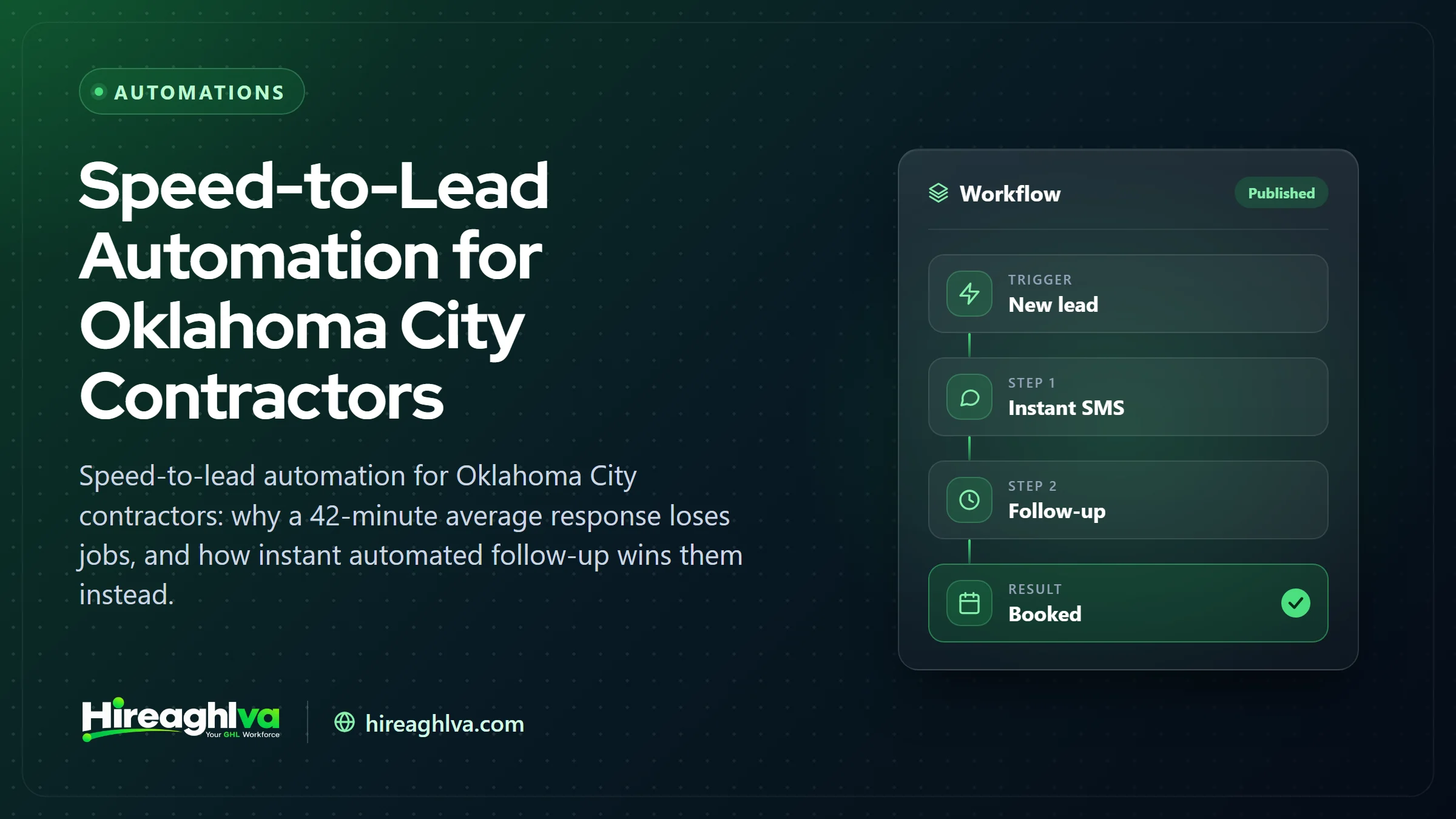
An Oklahoma City contractor doesn’t need to be the cheapest bid to win a job — they need to be the first one who actually responds. The contractor who responds first wins the job roughly 78% of the time, yet the median response time industry-wide is an estimated 42 minutes and around 27% of inquiries never get a response at all. A speed-to-lead automation closes that gap the moment a request comes in.
In plain numbers: The median first-response time for home service businesses is an estimated 42 minutes, and only around 12% of contractors consistently respond within 5 minutes, according to CustomerFlows’ 2026 contractor lead response time study. Roughly 27% of contractor inquiries never receive any response at all. Contractors who respond within 5 minutes are an estimated 21 times more likely to qualify a lead than those who take 30 minutes.
Here’s the plain version: a homeowner comparing three estimates typically books with whoever calls back first, not whoever eventually sends the lowest number. A contractor on a job site can’t compete on speed manually — the fix is making the first response automatic.
Why this matters especially in Oklahoma City
Oklahoma City is a growing metro with real opportunity to dominate local search early, which makes fast response a genuine competitive advantage right now:
- A market with room to build a lasting lead. A contractor who nails fast response now, before more competitors catch on, can build a real reputation edge that’s harder to close later.
- Seasonal demand spikes. Storm damage and HVAC failures during extreme weather create sudden bursts of inquiries exactly when a contractor has the least time to respond personally.
- Homeowners comparing multiple bids as standard practice. Requesting three-plus estimates is normal here, making response speed one of the few things a contractor fully controls in that comparison.
~42 min
Median first-response time for home service businesses
27%
Of contractor inquiries never get any response at all
78%
Of jobs go to whichever contractor responds first
| Item | Value |
|---|---|
| Responded to within 5 minutes (baseline) | 21x |
| Responded to within 30 minutes (comparison) | 1x |
Source: CustomerFlows, 2026 contractor lead response time study
These are broad home-services-industry figures, not an Oklahoma City-specific study — treat the exact numbers as directional. The consistent finding: response speed predicts who wins the job better than price, in study after study on this topic.
Why estimate speed decides who wins the job
Most contractors already suspect speed matters. What’s less obvious is why it matters this much for estimate requests specifically, rather than being a generic sales truism that happens to apply here too.
Homeowners request several bids at once, by habit now. Comparison-shopping a contractor the way people compare flights or hotels has become the default, not the exception — a homeowner planning a kitchen remodel, a new roof, or a fence replacement typically requests three to four estimates before picking anyone, often within the same day or two. By the time a business opens the request, the homeowner isn’t deciding whether to get more quotes; they already have several queued up, and whichever contractor reaches them first gets the first real conversation before the others even connect.
There’s almost no early differentiation on price. Materials and labor costs for a given job land in a similar range across reputable local contractors, especially before anyone has walked the site. That narrows what actually gets compared at the inquiry stage down to trust and responsiveness — and responsiveness is the one thing a homeowner can measure within minutes, long before any bid numbers exist to compare.
The homeowner has made zero commitment yet. A quote request is a form fill, not a booking. There’s no deposit, no signed estimate, nothing tying the homeowner to any one business. A slow response doesn’t just risk losing the job on price or quality — it risks the homeowner forgetting the business ever responded at all, because nothing held their attention in the meantime.
Insurance-driven jobs add a second, harder deadline on top of the first. When a request follows storm or hail damage, the homeowner isn’t just comparing contractors on who seems most trustworthy — they’re often working against an insurance adjuster’s schedule, a document-before-you-repair rule many carriers enforce, and sometimes a race against other contractors actively door-knocking the same damaged neighborhood. A contractor who responds in minutes can get in front of the adjuster’s visit and the homeowner’s decision; one who responds in two days may find a competitor already walked the roof.
Jobs cluster in time, and so does the competition for attention. A hailstorm, a heat wave that takes out HVAC systems across a neighborhood at once, or simply the spring and fall remodeling seasons all produce bursts of inquiries — often the same bursts that hit every other contractor in the area simultaneously. A business without a system watching the inbox is most exposed exactly when the most homeowners, and the most competing contractors, are all moving at once.
The cost of getting this wrong shows up directly in missed phone calls, not just slow callbacks on form submissions. Industry research on home service businesses has found the average missed call costs a contractor on the order of $200 to $500 in lost job revenue, and for bigger-ticket trades — a full roof replacement, an HVAC system, a major remodel — a single unanswered call can represent thousands of dollars of work that simply goes to voicemail and never gets booked. The same research suggests the large majority of people whose calls go unanswered never call back at all, which is exactly why an instant text acknowledgment matters as much for phone leads as it does for online estimate requests.
It’s also worth being honest about where the industry actually stands on this, because “everyone else is probably faster than us” is usually the wrong assumption for a contractor to make. A 2026 residential industry survey found that only about half of contractors respond to a new lead within the first hour — meaning the other half is leaving exactly the window that decides most jobs completely unmanaged, and odds of reaching a lead at all are reported to drop roughly tenfold just five minutes after the request comes in. A contractor who closes that gap isn’t competing against some theoretical best-in-class competitor; in a lot of cases, they’re simply doing what half the market still isn’t.
Oklahoma City’s market, in plain facts
A lot of “why this city is different” sections in local content are filler — generic growth talk that could apply to any city with the name swapped. Oklahoma City’s situation is specific enough to spell out, because it doesn’t change year to year the way a ranking list does.
Oklahoma City has been one of the faster-growing metros in the central U.S. for most of the last several years, and that growth isn’t just new jobs — it’s new rooftops. Regional planning estimates have pointed to tens of thousands of additional housing units needed across the metro over the next several years to keep pace with demand, with building permit activity fluctuating month to month but staying consistently active. Every one of those new homes eventually needs contractor work: a fence, a patio, an HVAC system reaching the end of its warranty, a remodel once a new owner settles in. New construction and resale turnover both feed a steady stream of homeowners who have no existing relationship with any local contractor yet — meaning every one of them is, by definition, shopping multiple bids with no loyalty to anyone.
The second piece is weather, and it’s not a minor detail for a home contractor serving this metro. Oklahoma sits inside what’s commonly called Tornado Alley, and central Oklahoma — including the OKC metro — sees a real, recurring pattern of severe spring thunderstorms, large hail, and tornado activity, concentrated heavily in the April-through-June window but capable of producing damaging storms well outside that season too. Hail is one of the most common drivers of residential roof damage anywhere it occurs, and a single significant hailstorm moving through a metro the size of OKC can generate estimate requests for hundreds of homes in the same week. That’s a fundamentally different inquiry pattern than routine remodeling demand: it’s a sudden spike, concentrated in specific neighborhoods, often running on an insurance claim timeline rather than a homeowner’s own schedule — and it hits every roofing and exterior contractor in the metro at the same moment, which is exactly the scenario where whoever answers first gets the walk-through.
Storm response in Oklahoma carries its own complications worth knowing if a contractor is building an automation around it. Oklahoma regulators have pursued enforcement action against insurers over how wind and hail claims get handled, and the state’s own guidance to homeowners is not to make permanent repairs until the insurance company has inspected the damage and agreed on cost — a step that changes what the first follow-up message should even say. A speed-to-lead workflow built for storm-driven roofing leads in Oklahoma needs language and next steps that fit that reality (documentation and a tarp first, permanent repair after the adjuster visit), not a generic “we’ll get your estimate right over” message that assumes a routine remodel timeline.
The third piece is density of competition. A fast-growing metro with recurring storm cycles attracts a lot of contractors chasing the same demand, including out-of-town storm-chasing crews that show up after a bad hailstorm and leave once the claims dry up. For an established local contractor, that competitive crowding makes response speed and visible legitimacy — a real local presence, real reviews, a fast professional follow-up — one of the clearest ways to stand out from a crew that showed up in a truck with out-of-state plates the week after the storm.
Put together: a growing population generating a steady baseline of new-homeowner demand, a weather pattern that reliably produces sudden spikes of high-value, time-sensitive roofing and exterior work, and a crowded field of local and storm-chasing competitors all chasing the same leads — that combination is exactly the scenario where a contractor who responds in minutes, every time, builds a durable edge over one who responds whenever someone gets around to it.
What a speed-to-lead automation for a contractor should include
A contractor speed-to-lead workflow, stage by stage
| Stage | What happens | When it should happen |
|---|---|---|
| 1. Instant acknowledgment | Text confirms the estimate request was received | Within seconds of the request |
| 2. Job details captured | Basic job type and location captured automatically | At first contact |
| 3. Task assigned with deadline | Whoever handles quotes gets a hard response window | Within minutes |
| 4. Escalation if no response | Automatically flags if the deadline passes | Same day |
How the workflow runs, job type by job type
The four stages in the table above look the same on a diagram regardless of what kind of job someone is requesting — but what actually needs to happen inside each stage changes a lot depending on the type of work. Treating a burst pipe, a kitchen remodel, and a hail-damaged roof the same way is one of the most common reasons a “speed-to-lead automation” ends up being a single generic autoresponder instead of something that actually matches how a contractor’s business runs.
Emergency repair (plumbing, HVAC failure, storm damage requiring immediate attention)
Emergency requests are the highest-urgency, lowest-patience category: a burst pipe, a failed AC unit in August, or storm damage letting water into the house. The acknowledgment needs to confirm the request landed and set an honest expectation for when someone will call or arrive — homeowners in this category aren’t comparing four bids on price, they’re trying to figure out who can actually show up. Routing should go straight to whoever is on call or closest to dispatch, and the response deadline should be the tightest of any category, often measured in minutes rather than hours. If the business can’t physically respond immediately — after hours, fully booked — the acknowledgment should say so honestly rather than implying a crew is already on the way, since a homeowner dealing with an active emergency will simply call the next number on the list the moment the first response feels uncertain.
Routine remodel or renovation estimate
A kitchen remodel, a new deck, a bathroom renovation — these requests have real urgency but not emergency urgency, and the homeowner is usually mid-comparison across several contractors rather than reacting to a crisis. The acknowledgment can be a little more detailed here: confirming the job type, asking a qualifying question or two (rough scope, timeline, budget range), and setting an expectation for a scheduled estimate visit rather than an immediate callback. Routing goes to whoever handles estimates for that trade, with a response deadline measured in hours rather than minutes — same business day is usually the right bar, since this is where the “78% of jobs go to whoever responds first” dynamic plays out most directly against other bids landing in the same homeowner’s inbox.
Insurance-claim-driven roofing and storm-damage work
This category behaves differently from both of the others because the timeline isn’t fully set by the contractor or the homeowner — it’s set partly by the insurance adjuster’s schedule and the carrier’s claims process. The acknowledgment should capture whether the damage is likely insurance-related and, if so, set expectations around documentation (photos, a tarp if needed) before any permanent repair, since making repairs before an adjuster inspects the damage can jeopardize the claim itself. Routing should go to whoever on the team handles insurance-claim jobs specifically, since those often involve supplementing the estimate to match the adjuster’s scope and working directly with the carrier — a skill set that’s different from quoting a cash remodel job. Because storm-damage requests cluster heavily right after a bad weather event, this is also the category most likely to overwhelm a manual process entirely: a hundred roofing inquiries landing in the same week after a hailstorm is exactly the volume a human team can’t individually triage fast enough, and exactly where an automated first response and task-assignment system earns its cost in a single storm cycle.
Common mistakes contractors make trying to fix this themselves
Most contractors who are losing jobs to slower response haven’t done nothing about it — they’ve usually already tried something. These are the mistakes that keep that something from actually working.
- Treating every job type as one pipeline. A single catch-all “new lead” workflow sends the same message and routes to the same person whether someone has a burst pipe or wants a kitchen remodel quote, which means emergency requests wait behind routine ones and routine requests get an oddly urgent-sounding message meant for a crisis.
- Sending one acknowledgment text and calling it done. An instant “we got your request!” text is the start of the workflow, not the whole thing. Without a task assigned to a specific person and a real deadline behind it, that first message is a dead end the moment the homeowner replies with a question.
- No escalation path when the assigned person doesn’t respond. Everyone has a day where they’re on a roof, in a crawl space, or simply slammed. Without an automatic escalation to a backup or the owner when the deadline passes, the lead sits exactly where a fully manual process would have left it.
- Ignoring after-hours and weekend requests. A meaningful share of estimate requests and emergency calls come in evenings and weekends, when crews are off the clock — a workflow that only runs during business hours leaves exactly the highest-urgency requests sitting unmanaged.
- Firing too many messages too fast. Overcorrecting with three texts and two emails in the first twenty minutes reads as desperate rather than responsive, and gives a homeowner who was on the fence a reason to opt out of the whole sequence.
- No separate process for storm-driven spikes. A workflow tuned for the normal, steady trickle of remodel inquiries can get buried the week a hailstorm hits and two hundred roofing requests land in three days — without a plan for that volume spike specifically, the busiest, highest-value week of the year is also the week response time quietly falls apart.
- Building it once and never testing it again. Pipelines get renamed, a new lead source gets added, a form field changes — and a workflow built a year ago can quietly stop firing for one of those sources without anyone noticing until a homeowner mentions they never heard back.
- No visibility into actual response time. Without tracking how long leads actually wait for a first response, there’s no way to know whether the automation is working, or has quietly broken for one lead source, one job type, or one time of day — see our GoHighLevel missed-call text-back guide for how the same visibility gap shows up with phone leads specifically.
Before and after: what actually changes
Estimate request gets an instant acknowledgment
- With speed-to-lead automation
- Without it
A specific person is assigned with a deadline
- With speed-to-lead automation
- Without it
Escalates automatically if nobody responds
- With speed-to-lead automation
- Without it
Depends on someone checking messages eventually
- With speed-to-lead automation
- Without it
| With speed-to-lead automation | Without it | |
|---|---|---|
| Estimate request gets an instant acknowledgment | ||
| A specific person is assigned with a deadline | ||
| Escalates automatically if nobody responds | ||
| Depends on someone checking messages eventually |
What this costs, and what it’s worth
How the common approaches to estimate follow-up compare
| Approach | Setup effort | Ongoing cost structure | Risk of leads slipping through |
|---|---|---|---|
| No automation — manual inbox/phone checking | None | No direct cost, but ties up staff time ad hoc | High — depends entirely on who happens to check, and when |
| Generic autoresponder plug-in | Low — a few hours | Flat monthly SaaS fee | Medium — acknowledges instantly but does not route, assign, or escalate |
| Built speed-to-lead workflow (job-type routed) | A few days to about a week, one-time build | Fixed build cost plus a GoHighLevel subscription | Low — a missed deadline escalates automatically instead of going quiet |
| Dedicated front-desk or dispatcher hire | Ongoing hiring and management | Salary and overhead every month | Low, but expensive to justify outside the busiest storm weeks |
The honest way to frame return on investment here isn’t “how many extra jobs does this generate” — it’s “how many jobs is the business already generating demand for, that are currently going to whoever called back faster.” The advertising spend, SEO, truck wraps, or referral relationships that produced the estimate request have already been paid for by the time the inquiry lands; a slow response doesn’t just lose that one job, it wastes everything spent getting the homeowner to reach out in the first place.
Run the math against an average job value and the case gets clearer fast. A routine remodel or exterior job in the Oklahoma City metro commonly runs from a few thousand dollars for smaller work up into the tens of thousands for a full remodel, kitchen, or roof replacement — and a hail-damaged roof claim, paid through insurance, frequently lands well into five figures once the adjuster’s scope is finalized. Recovering even one or two jobs a month that would otherwise have gone to a faster-responding competitor usually covers the cost of a build many times over, because it’s recovered revenue against demand the business already has, not new spend chasing new leads.
It’s also worth comparing this to the alternative of simply hiring to solve the same problem. A dedicated front-desk person or dispatcher whose job is to watch for new requests and respond fast runs a recurring salary cost every month regardless of how many requests come in that week, doesn’t scale down during a slow month, and still depends on that person being at their desk rather than out sick or on a job site. A workflow doesn’t call in sick, doesn’t need a schedule, and handles a two-hundred-inquiry storm week at the same cost as a quiet one — which matters most in exactly the weeks where manual response is least able to keep up.
How to tell a real speed-to-lead system from a basic autoresponder
Plenty of things get sold as “speed-to-lead” that are really just an autoresponder with a better name. Before paying for one — whether from us or anyone else — these are the questions that separate a real system from a single automated text.
- “What happens after the first message sends?” If the honest answer stops at “it sends a text,” that’s an autoresponder, not a workflow. A real system creates a task for a specific person, with a visible deadline, and something that happens automatically if that deadline is missed.
- “How does it treat an emergency call differently from a remodel estimate?” If every request gets the same message and the same response deadline regardless of urgency, the “system” isn’t actually using the information the homeowner already gave it.
- “What happens during a storm-driven volume spike?” Ask specifically how the workflow behaves when two hundred roofing inquiries land in the same week — a vendor who hasn’t thought about that scenario hasn’t actually built for how this business works.
- “What happens if the assigned person doesn’t respond in time?” This is the escalation step, and it’s the single biggest differentiator between a system that catches mistakes and one that just delays them. There should be a concrete answer — a specific backup person, and a specific time window — not a vague “it follows up again.”
- “Can I see response-time reporting, or do I just have to trust it’s working?” A real system can show median time-to-first-contact and what share of leads got reached inside the target window. Without a way to measure it, there’s no way to know six months from now whether it’s still working.
- “Who owns the workflow if we ever switch providers?” Make sure it lives in a platform the business actually controls — like its own GoHighLevel account — rather than locked inside a vendor’s black-box tool that would need to be rebuilt from scratch to leave. This is also the question that decides whether a dedicated GoHighLevel VA or an in-house hire makes more sense for managing it day to day.
- “How does the automation handle insurance-claim documentation requirements?” A workflow built without any awareness of the “don’t make permanent repairs before the adjuster inspects” rule can accidentally push a homeowner toward a step that jeopardizes their own claim — a vendor who’s thought about storm work specifically will have an answer ready.
- “What does testing and ongoing maintenance actually look like?” Pipelines get renamed, forms change, a new lead source gets added — ask what happens when that breaks something, and whether re-testing is part of the deal or a separate bill every time.
A basic autoresponder isn’t worthless — an instant acknowledgment beats silence every time — but it’s solving a smaller slice of the problem than most contractors think they’re buying. The acknowledgment is stage one of four. A system that stops there is still leaving the other three stages to chance.
What you actually get
- You stop losing jobs to whoever simply called back faster. The acknowledgment buys the time a live callback can’t always happen in.
- Nothing falls through the cracks during a busy storm season. The escalation step catches a request an overwhelmed team might otherwise miss entirely.
- You get a documented process your whole team follows the same way, instead of response speed depending on who happens to be free — the same speed-to-lead structure that applies to any lead-driven business.
- You build a real reputation edge early, in a market where fast response is still a genuine differentiator — the same local SEO fundamentals that bring the inquiries in also reward fast, consistent follow-up.
Bringing it together
An Oklahoma City contractor with a growing lead flow doesn’t need more inquiries if over a quarter of them never get a response — it needs a system that responds the instant the request lands. Pair speed-to-lead automation with a full contractor snapshot that handles the rest of the estimate-to-booked-job pipeline, and a fast contractor website, and the whole intake process runs on speed instead of luck.
Written by the Hireaghlva GoHighLevel team
We build and run GoHighLevel accounts, automations, dashboards, and websites for agencies and local businesses across the US and Canada. This guide reflects that hands-on work, with sources cited inline where we reference outside data.